
I’m beginning to realise that getting better doesn’t mean life stops being difficult. It means I might finally be learning that I have a choice in how I respond.
Something has changed over the last week or so. Nothing dramatic. No sudden revelation, no miraculous transformation, no moment where the clouds parted and everything became wonderful. Life is still life. Work is still work. People are still capable of being spectacularly irritating, and my brain is still perfectly capable of taking something relatively ordinary and turning it into a catastrophe. But something is different, and I think I’m beginning to understand what it is.
I’m starting to realise that I don’t have to suffer simply because somebody else is badly behaved. I don’t have to accept being spoken down to, dismissed or made to feel small. I don’t have to spend days analysing what somebody meant, what I should have said, what might happen next or whether I’ve somehow done something wrong. I think I’m beginning to recognise that I have choices. That might sound ridiculously obvious to somebody who hasn’t spent much of their life feeling as though things happen to (or at) them rather than being things they have any control over. But for me, it’s quite a significant development. And it’s taken an awful lot to get here.
The Old Familiar Feeling
Something happened at work recently that brought a lot of familiar feelings bubbling back to the surface. I won’t go into the specifics because the details aren’t important, and this isn’t really about the individual involved. It’s about what happened inside my head afterwards. I’d been involved in putting together an early draft of a document. It wasn’t supposed to be perfect. It was a starting point, something to establish whether we were heading in the right direction before investing more time in refining it. That’s how these things work. You put something together, somebody reviews it, you discuss what’s right and wrong, and you improve it.
The response was dismissive, I was spoken to like I was a child. There was a suggestion that the document was too AI-driven, that reviewing it further would be a waste of their time, and that it needed rewriting. Now, I’m perfectly capable of accepting criticism. I’ve spent decades working in technology, and if there’s one thing I’ve learnt, it’s that the first version of almost anything is rarely the best version. Yes, I’d used co-pilot to merge information from three separate places (a requirement, and some bugs, all written by either myself or a engineer). I’d been through and removed the AI dross from the document, but kept the key talking points, all I wanted was to check that I’d captured the right topics, not that a word for word critique of it. Feedback is necessary. Constructive criticism is valuable. Sometimes somebody needs to tell you that what you’ve produced isn’t working. But there’s a difference between saying something needs improvement and making somebody feel that their effort wasn’t worth their time.
Finding Anger
And that’s where something rather unsettling happened. The old me would probably have immediately started questioning myself. Had I done something wrong? Was the document rubbish? Had I misunderstood what was required? Was this going to become a problem? Would somebody think less of me? What would happen next? I might have spent the evening replaying the conversation, constructing increasingly elaborate scenarios about the consequences, and wondering how to fix something that might not even have been broken.
This time, I was angry. Not frightened. Not immediately convinced I’d failed. Angry. And I think that matters.
Anger is something I’ve had a complicated relationship with for most of my life. I’ve often treated it as something dangerous, something that needs suppressing. It’s been easier to turn it inward, to punish myself, to apologise, to smooth things over, or simply to accept behaviour that I wouldn’t dream of directing at somebody else. There are reasons for that, and some of them go back a very long way.
When you’ve experienced people abusing their authority, violating your boundaries or making you feel powerless, you can become extraordinarily sensitive to the way other people exercise control. A particular tone of voice, a dismissive comment or somebody talking down to you can bring back feelings that have very little to do with the situation. It’s not necessarily the words themselves. It’s what they represent.
I have a right not to be spoken to like that. I have a choice!
I’m not that child anymore. I’m a fifty-year-old man with decades of professional experience, a brain that works perfectly well, and every right to expect to be treated with respect, and like a flipping adult. I can disagree with somebody. I can tell them that their approach isn’t constructive. I can challenge their behaviour without attacking them as a person. And I can do all of that without needing their permission. There are grown up ways of doing these things, and they chose the wrong one. That’s quite a thing to realise.
One of the things I’ve been exploring is the idea of responding as an adult rather than allowing myself to be pulled back into those old patterns. It sounds simple enough. Somebody behaves badly, you respond calmly and appropriately, and everyone gets on with their day. Except it isn’t that simple when your nervous system has spent years treating certain interactions as threats. The instinct can be overwhelming. Apologise. Retreat. Prepare for the worst. Or occasionally, when the frustration becomes too much, tell somebody exactly what you think of them in language that probably wouldn’t improve the situation.
I wanted to respond publicly and tell them not to speak to me in that way. But I didn’t. Not because I was frightened of the consequences, or because I’d decided their behaviour was acceptable. I stopped because I recognised that reacting in that moment wouldn’t achieve what I wanted. I just didn’t have to do it immediately, publicly or angrily.
That’s the difference I’m beginning to understand. Having a choice doesn’t mean I have to exercise it at the first available opportunity, and choosing not to engage isn’t necessarily the same thing as surrendering. Six months ago, I’m not sure I could have made that distinction. Back then, I think I would have been far more concerned about what might happen if I challenged somebody than whether their behaviour deserved challenging in the first place.
Something came out of a conversation that has stayed with me: I choose not to suffer.
I choose not to suffer
Now, before you think I’ve discovered some magical cure for depression, anxiety or trauma, I haven’t. If only it were that bloody easy. I can’t simply decide that something won’t hurt. I can’t switch off a trauma response because it’s inconvenient. I can’t instruct my brain to stop producing catastrophic predictions and expect it to obey. Believe me, I’ve tried. But I am beginning to realise that there’s a difference between experiencing pain and allowing that pain to dictate everything that happens afterwards.
Somebody can upset me without ruining my entire day. A difficult conversation doesn’t have to become a week of anxiety. Somebody else’s opinion doesn’t automatically become the truth about me. I can acknowledge that something hurt, decide whether it requires a response, and then try to get on with my life. Sometimes I’ll manage that. Sometimes I won’t. There will undoubtedly be days when the old patterns come roaring back and I’ll find myself mentally preparing for disasters that never happen. But even recognising that I’m doing it is progress.
And something else has been happening. The physical reactions seem to be getting a little quieter. Not disappearing, but diminishing. The rush of anxiety, the feeling of impending disaster, the sense that something terrible is about to happen. They’re still there occasionally, but perhaps not quite as overwhelming. It’s happening in fractions rather than great leaps, and I’m beginning to think those fractions matter more than I’ve been giving them credit for.
The Waves and the Lifeboat
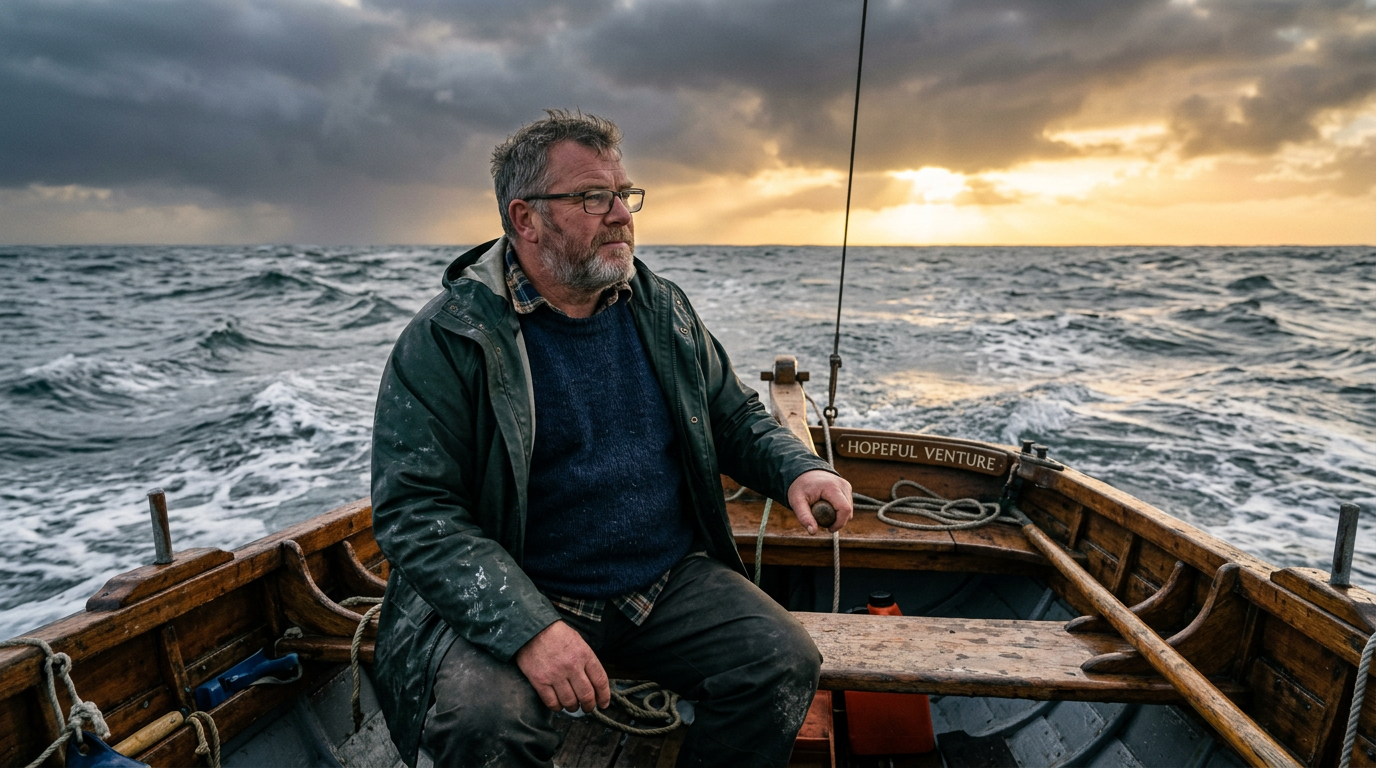
During my weekly therapy session this week, we talked about recovery as being rather like sitting in a lifeboat in the middle of the sea. The waves keep coming. Some are small, some are enormous, and occasionally one appears from nowhere and knocks you sideways. For a long time, I’ve just been trying to simply survive the waves on my own, with no lifeboat in sight.
A few months ago, my boat was barely staying afloat. Every wave felt enormous, and I was exhausted from constantly trying to keep the water out. What I’ve been learning is that there was always a lifeboat there, but it was out of reach, and quite frankly knackered and leaking. Now, perhaps, I’m beginning to repair it. The waves haven’t stopped, but some of them don’t feel quite so big anymore. And occasionally, when one hits, I find myself thinking that I can deal with it rather than immediately assuming I’m going to drown.
This new enclosed harbour, with a lifeboat is a very different place to be.
Learning to Live Without the Pain
One of the stranger things we discussed was something I experienced after my hip replacements some years ago. Before the operations, I’d lived with chronic pain for years. It was exhausting, limiting and, at times, utterly miserable. I wanted it gone. And then, after the surgery, much of that familiar pain disappeared. What surprised me was that, in a very peculiar way, I missed it.
Not because I wanted to hurt again. Of course I didn’t. But the pain had become such a constant part of my existence that its absence felt strange. My brain had grown accustomed to it being there. I’ve been wondering whether something similar is happening emotionally. For so long, anxiety, fear, shame and the expectation that something bad is about to happen have been familiar companions. Unpleasant companions, certainly, but familiar ones.
What happens when they begin to disappear? Perhaps that can feel unfamiliar too, and perhaps part of recovery is learning to live without the pain you’ve become accustomed to carrying. Could I one day actually miss feeling how I have felt in the recent past?
I’m starting to recognise that feeling strange when things are okay doesn’t mean something is wrong. Sometimes okay is simply okay. There’s something else I need to remind myself of, particularly now that I’m back at work and doing normal hours again. Being back doesn’t mean I’m recovered. I think there’s a tendency, particularly in the workplace, to see somebody returning to their usual routine and assume that everything must be fine. They’re attending meetings, delivering work, making decisions and generally functioning, so whatever happened must be behind them.
Nobody has the right to drag me back to my darkest place
A few months ago, I reached one of the darkest moments of my life. That doesn’t simply disappear because I’ve managed to return to work, attend meetings and produce documents. The work I’m doing on myself is going to take time. Probably years. There are decades of experiences, beliefs and behaviours to understand, challenge and gradually change. And I’m beginning to accept that.
What I don’t want is to spend those years simply learning how to tolerate the same things that made me miserable in the first place. I don’t want recovery to mean becoming better at enduring things. I want it to mean becoming better at living. That means learning to establish boundaries, recognising when something isn’t acceptable, and understanding that I have a right to make decisions about my own life. It also means accepting that other people might not always like those decisions.
And perhaps that’s one of the biggest changes of all. For much of my life, I’ve been so concerned about how other people might react that I’ve forgotten to consider what I actually want. I’m beginning to ask that question again.
The Tides They Are A-Changin’
I don’t want to overstate what’s happened over the last week. I’m not suddenly fearless. I’m not immune to criticism. I haven’t developed some extraordinary ability to brush off everything that happens around me. There are still moments when my brain starts constructing its familiar disaster scenarios. There are still people who can trigger feelings that belong to a much earlier part of my life. And there are still days when everything feels harder than it should.
But I can see changes. I’m noticing my reactions rather than simply being consumed by them. I’m questioning the stories my anxiety tells me. I’m beginning to recognise that somebody else’s behaviour doesn’t automatically say something about my worth. And perhaps most importantly, I’m becoming less willing to abandon myself simply to keep somebody else comfortable.
And maybe that’s what recovery is beginning to look like. Not a life without waves. Not a world where nobody ever hurts me. Not even a brain that never gets frightened. Just a stronger boat, a little more confidence in my ability to steer it, and the growing realisation that I don’t have to spend the rest of my life being carried wherever the current takes me.
For the first time in a very long time, I’m beginning to feel that I might actually have some say in where I’m going.